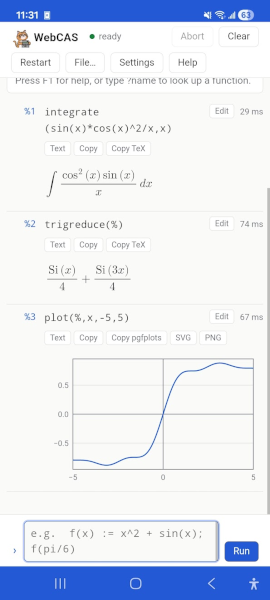
The image capture included here demonstrates the use of WebCAS
evaluating, and then plotting, a somewhat non-trivial integral. This
example should make it evident that WebCAS is not a toy: its capabilities
may not match those of the frontier-class CAS applications, but it is
a practical, usable tool nonetheless.
Use case: An example from general relativity
To demonstrate just how useful WebCAS is, its limitations notwithstanding,
let us use it to derive the Schwarzschild solution of general relativity,
i.e., the canonical "black hole" spacetime metric. Without further ado,
here is the script:
lcs(g,c):=block(local d:=length(c),r:=table(zeros(d,d),k,1,d);
  for k from 1 to d do
    for l from 1 to d do
      for m from 1 to d do
        r[k][l][m]:=1/2*(diff(g[k][l],c[m])+diff(g[k][m],c[l])-diff(g[l][m],c[k]))
      end
    end
  end;
r);
mcs(g,c):=block(local G:=g^-1,L:=lcs(g,c); table(sum(G[k,l]*L[k],k,1,4),l,1,4));
R(g,c):=block(
  local d:=length(c),
        G:=mcs(g,c),
        R:=table(table(zeros(d,d),k,1,d),l,1,d);
  for k from 1 to d do
    for l from 1 to d do
      for m from 1 to d do
        for n from 1 to d do
          R[k][n][m][l]:=diff(G[k][l][m],c[n])-
                         diff(G[k][l][n],c[m])-
                         sum(G[a][l][n]*G[k][a][m],a,1,d)+
                         sum(G[a][l][m]*G[k][a][n],a,1,d)
        end
      end
    end
  end;
R);
depends([A,B],r);
lg:=diagmatrix([B,-A,-r^2,-r^2*sin(theta)^2])

coords:=[t,r,theta,phi]

S:=simplify(sum(R(lg,coords)[k][k],k,1,4).lg^-1);
E:=simplify(S-1/2*trace(S)*identity(4))

T:=solve(exp(logcombine(subst(C1=log(2*G*M),dsolve(numer(E[1,1])=0,A)),"positive")),A)

densityplot(subst([G=1/(10*M),r=sqrt(x^2+y^2)],rhs(T[1])),[x,-10,10],[y,-10,10])
These five chunks of code can be copy-pasted into WebCAS one chunk at a time, as indicated by the extra
line breaks above.
The script contains a generic function to calculate the Christoffel symbols
of the first and second kind (lcs and mcs) and the Riemann
tensor R; then, a generic spherical metric is postulated by means
of the unknown functions A and B of the radial coordinate r.
Next, the Ricci tensor S and the Einstein tensor E are
computed. Solving for E[1,1]=0 (vacuum solution) yields the well-known
form of the Schwarzschild metric. Finally, the solution is plotted as a
density plot.
Building complex applications with LLM help
Needless to say one does not build a 26,000-line software application overnight
without help. WebCAS was built using Claude Opus 5.5. However, Claude was not
used in an "agentic" role, where the AI would take over the process of
development and testing.
Rather, in the process that was followed, the human
retained the role of senior developer. The AI was used in chat mode as an extremely
capable and knowledgeable assistant, but the development process remained under
human direction, and integration and testing was also performed by the human
user.
While this approach may seem somewhat inefficient, it ensures that the human
developer remains very much in the loop, with full understanding of the
software architecture and its quirks, rather than being relegated to a more
distant "project manager" type of role.
What made this project possible is the extremely generous input context
window size of modern language models. Claude Opus 5.5 has a 1-million
token input limit. The final context size of the WebCAS development
conversation consumed almost 800,000 tokens, maximally epxloiting this
frontier model's capabilities.
elizaGPT... »